
Insights · materials · 7 min read
House Exterior Materials: What Ages Well on the Coast
LUSO Architecture
CIAT Chartered Practice · 8 October 2026
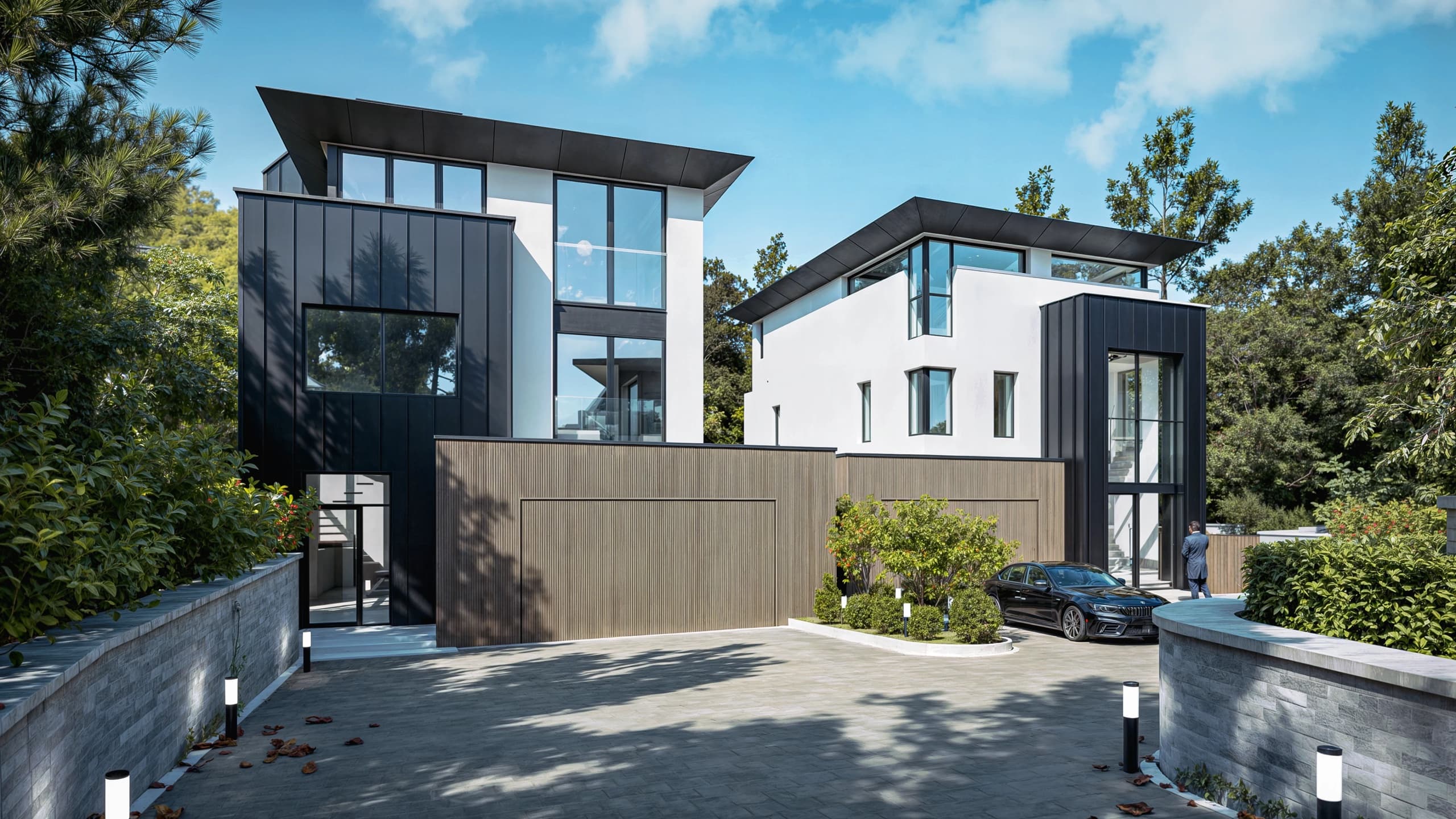
Most exterior materials are chosen on a dry afternoon, held in the hand, under good light. That is the least reliable way to judge them. A facade on the south coast spends its life in salt air, rain driven in off the Channel, low winter sun and, further inland, the steady drip of trees.
The useful question is not how a material looks on handover day. It is how it looks in year ten, on a grey February morning, after a decade of weather.
When we think about exterior materials on this stretch of coast, we treat them less as finishes and more as surfaces that will be changed by their surroundings. Some materials accept that change gracefully. Others resist it, and lose.
The coast is its own climate
On the clifftops of Canford Cliffs and the exposed edges of Sandbanks, wind carries salt onto every surface. Painted finishes chalk and fade. Ordinary steel fixings corrode and bleed. Timber on the windward face greys long before the sheltered side.
Move inland to Ringwood or into the New Forest and the problem changes character. Less salt, more shade. Moisture lingers on north-facing walls and beneath tree canopies, and green growth follows.
The same material can therefore age in quite different ways a short drive apart. Before we discuss a palette, we look at orientation, exposure, overhanging trees and where the prevailing weather actually arrives. A material is only good or bad in relation to a specific wall.
Stone: the material that deepens
Good stone does not so much age as settle. Its colour softens, its texture becomes more legible, and small marks read as character rather than damage.
Dorset has a long tradition of building in local limestones such as Purbeck and Portland, while flint and brick are more familiar across parts of Hampshire. Stone with a history in the region has, in effect, already been tested by the climate it will live in. That is worth more than any sample board.
A few decisions matter more than the choice of stone itself:
- Bedding. Sedimentary stone is generally laid as it formed in the ground. Stone set the wrong way can weather in layers. A competent supplier and mason will know how each block should sit.
- Mortar. Joints should usually be softer than the stone, so that movement and moisture are taken by the joint, which can be repointed, rather than by the stone, which cannot easily be replaced.
- Texture. A split or tooled face carries weathering and staining far more gracefully than a smooth, sawn one. Pale, polished stone that looks immaculate in the showroom is often the first to show streaks.
Ask your supplier where the stone has been used in an exposed coastal setting, then go and look at it.
Timber: design for the silver
Unfinished timber left to the weather turns grey. Oak, larch, cedar and thermally modified timbers all do it, at different rates and in different tones. That silvering is beautiful, provided the design expects it.
The common failure is uneven weathering. Boards under a deep eave stay warm and honey coloured; boards in full weather turn silver; the line between the two becomes a permanent tidemark. Window reveals, balcony soffits and the shadow of a neighbouring wall all produce the same effect.
There are two honest responses. Either expose the cladding evenly so it weathers as a whole, or protect it consistently. Pre-weathered and factory-treated boards can also shorten the awkward middle years.
The smaller details decide whether timber lasts:
- Fixings should be stainless steel suited to a marine environment. Ordinary steel reacts with the tannins in timbers such as oak and leaves black streaks that do not wash out.
- A ventilated cavity behind the boards lets them dry after rain.
- Clearance from the ground keeps boards out of the splash zone, where soil and rain bounce back onto the base of the wall.
- End grain should be protected or concealed, because it is where water enters first.
If you prefer a stained or painted finish, choose it knowingly. Coated timber needs recoating on a regular cycle, and coastal exposure shortens it. That is a perfectly reasonable choice, but it is a commitment, not a finish.
Render: usually blamed for the detailing
Render has a poor reputation on the coast, and most of it is undeserved. When a rendered house looks tired, the render is rarely the cause. The water is.
Dark streaks beneath window cills, green bloom at the base of walls, hairline cracks radiating from corners: these are almost always the visible record of where water has been allowed to run, sit or concentrate.
The material choice still matters. Through-coloured mineral and lime renders tend to age more softly than a painted surface, because there is no film to peel or fade. But the decisions that protect a rendered facade are mostly geometric:
- Cills and copings that project beyond the face of the wall, with a drip beneath, so water falls clear rather than running down the render.
- A plinth in a harder, darker material at ground level to take splash and dirt.
- Movement joints placed deliberately, aligned with openings and junctions, rather than cracks appearing where they choose.
- Colour chosen with honesty. Brilliant white on a shaded wall beneath trees will rarely stay brilliant. A warm off-white, a stone tone or a soft earth colour forgives a great deal more.
Detailing does most of the work
Across all three materials, the pattern is the same. Longevity is designed in at the junctions.
We find it helpful to draw where the water goes. Follow a raindrop from the roof edge to the ground and every weak point reveals itself: the parapet without a coping, the window head without a drip, the cladding that stops a few centimetres short of where it should.
Metals deserve particular care near the sea. Different metals in contact can corrode one another in salt air, so flashings, fixings, balustrades and window frames should be considered together rather than specified piece by piece.
Fewer materials, better junctions
A restrained palette usually ages best. Two or three materials, each used with conviction, will look more resolved in year ten than five materials competing for attention.
There is also a practical logic. Every change of material is a junction, and every junction is somewhere water can find its way in. A heavier base of stone or brick beneath a lighter upper storey of timber or render reflects how those materials actually weather: the robust one meets the ground, the more delicate one sits above the splash.
Materials and the planning authority
In Conservation Areas and in the New Forest National Park, materials are often central to the planning conversation, and approvals can come with conditions requiring samples to be agreed before work begins. Each authority has its own expectations. Our guide to planning permission in the New Forest National Park sets out how planning works inside the park, and your planning authority can confirm what applies to a particular site.
The year-ten test
Before committing to any exterior material, ask five questions of it:
- How does it look wet?
- Where will water run across it, and what will that leave behind?
- How will the sheltered parts compare with the exposed parts?
- What maintenance does it need, and will you genuinely do it?
- Is there a building nearby where this material has already been in place for ten years?
The last question is the most valuable. Walk the street. Look at the sea-facing houses, the shaded ones, the ones nobody has repainted. The coast has already run the experiment for you.
If you are planning a new home on the coast or in the Forest and would like to think through a material palette with us, our new build homes page explains how we approach the design process from first sketch to detailed specification.