
Insights · planning · 8 min read
Planning permission in Poole, Bournemouth and Christchurch: a homeowner's guide
LUSO Architecture
CIAT Chartered Practice · 8 October 2026
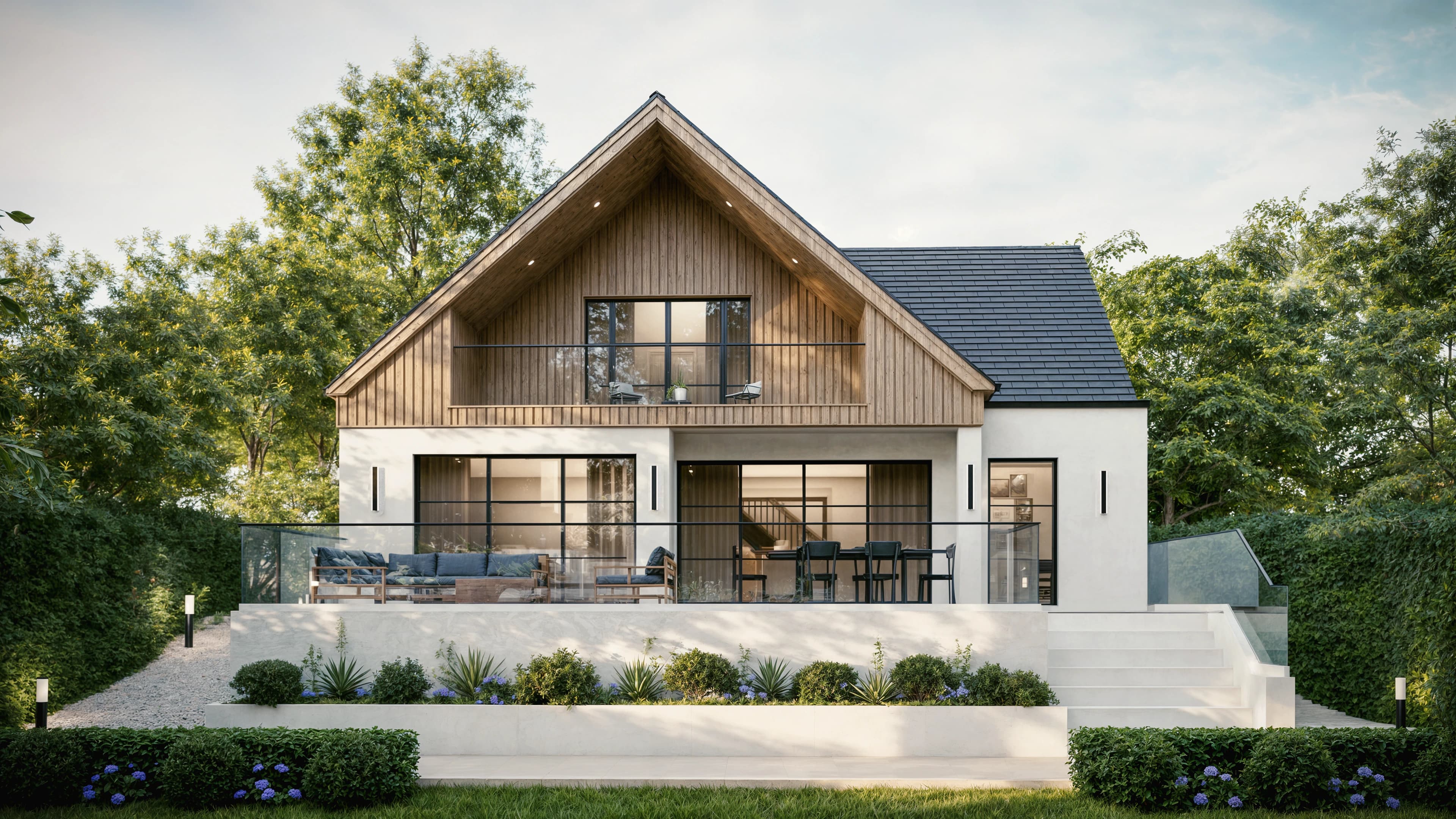
Extensions, loft conversions, replacement dwellings and new homes in Poole, Bournemouth and Christchurch need planning permission unless the work falls within national permitted development rights, which cover many smaller extensions and loft conversions. Applications are decided by BCP Council (Bournemouth, Christchurch and Poole Council), the local planning authority for all three towns. Planning officers decide most applications, and more complicated ones go to the Planning Committee.
This guide was last checked in October 2026. Planning rules and fees change, and BCP Council's own pages are the authority.
Key facts
- From 1 April 2026 a householder application costs £548, and a full application for fewer than 10 new homes costs £610 per dwelling.
- The statutory decision period is 8 weeks for most applications and 13 weeks for major development.
- Public consultation normally lasts 21 days, and no decision can be made before it ends.
- BCP Council has 48 conservation areas, where permitted development rights are more limited.
- New housing within 400 metres of the Dorset Heathlands is strictly controlled, and mitigation is required from there out to 5km.
- A householder refusal can be appealed within 12 weeks, free of charge.
Do I need planning permission for an extension in Poole?
Not always, because many house extensions are permitted development, a national grant of planning permission for certain works within set limits. The Planning Portal lists the main ones for houses in England:
- A single-storey rear extension can project up to 4 metres beyond the rear wall of the original house if it is detached, or 3 metres for any other house.
- Those depths rise to 8 metres and 6 metres through a prior approval application, except on designated land such as conservation areas.
- A side extension must be single storey and no wider than half the original house.
Anything beyond these limits needs a householder application. The rights apply to houses, not flats or maisonettes. Related pages: extensions and renovations, Poole, Bournemouth and local work at Covena Road in Southbourne.
Do I need planning permission for a loft conversion?
A loft conversion is permitted development if it stays inside the national limits. Added roof volume must not exceed 40 cubic metres for a terraced house or 50 cubic metres for any other house, and the enlargement must not rise above the existing roof. In a conservation area this kind of roof enlargement is not permitted development, so an application is needed.
When are permitted development rights removed or restricted?
Permitted development rights are reduced on designated land, under an Article 4 direction, or by a condition on an earlier planning permission.
- Conservation areas. BCP Council's list includes Sandbanks and Canford Cliffs Village and Ashley Cross in Poole, Westbourne and East Cliff in Bournemouth, and Christchurch Central and Mudeford Quay. Here all side extensions, rear extensions of more than one storey and exterior cladding need planning permission, as does most demolition.
- Article 4 directions. A council can withdraw specific rights across a defined area. One covers the Bournemouth area and Talbot Village in Poole, where converting a house to a small house in multiple occupation needs permission.
Work to a tree with a Tree Preservation Order needs the council's permission. In a conservation area, 6 weeks' written notice is required before work to a tree with a stem over 7.5cm in diameter, measured 1.5 metres above ground.
Householder or full application: which one applies?
A householder application is for altering or enlarging a single house, including works within its garden. Flats, more than one house and changes of use need a full application, and so does a new or replacement dwelling. Local residential work by the practice includes Springfield Road in Ashley Cross, Martello Road in Canford Cliffs and Broadway at Hengistbury Head. See also new build homes and Christchurch.
How much does a planning application cost?
A householder application costs £548, and a full application for new homes costs £610 per dwelling on schemes of fewer than 10. Fees are set nationally and rise each 1 April with inflation.
| Application type | Fee from 1 April 2026 |
|---|---|
| Householder application, single house | £548 |
| Full application, new homes (fewer than 10) | £610 per dwelling |
| Prior approval, larger rear extension | £249 |
The Planning Portal adds a service charge to online applications with a fee over £100: £99 or £149 including VAT at the time of checking, depending on application type.
What does BCP Council need to validate an application?
BCP Council's local validation checklist, updated June 2026, lists what must be submitted. For a householder application that is:
- Application form, ownership certificate and the correct fee
- Location plan at 1:1250 or 1:2500 and a site or block plan at 1:200 or 1:500
- Existing and proposed elevations and floor plans, plus roof plans where the roof changes
- Photographs of the front, sides and rear of the house
Some sites also need a flood risk assessment, heritage statement, arboricultural impact assessment, bat survey or coastal vulnerability assessment. Documents must be PDFs, and Land Registry plans or unlicensed Ordnance Survey maps are rejected as location plans.
How long does BCP Council take to decide?
The statutory period is 8 weeks for most applications and 13 weeks for major development, unless a longer period is agreed in writing. If a non-major application is still undecided after 16 weeks with no agreed extension, the fee is refundable under the national planning guarantee. Once granted, permission normally requires work to begin within 3 years.
Does BCP Council offer pre-application advice?
Yes, as a paid service. Its guidance notes list written householder advice at £180, or £300 with a site visit and meeting. For a single new or replacement dwelling the range is £420 to £600. The council aims to reply within 25 working days for householder and minor schemes, and the advice is not binding. The notes add that an application submitted without pre-application discussion, with problems that cannot be resolved in the statutory period, will not normally be negotiated and is likely to be refused.
What extra rules apply to new homes?
Any net gain in homes in the BCP area needs a legal agreement to mitigate effects on protected habitats, requested at validation.
- Dorset Heathlands. Residential development within 400 metres is strictly controlled. Between 400 metres and 5km the council seeks £550 per house or £376 per flat, plus an admin fee.
- Poole Harbour. In the Poole area a recreation contribution of £195 per house or £134 per flat applies. Since 30 November 2025, additional homes in the harbour catchment must also show nutrient neutrality using Natural England's calculator, through the applicant's own mitigation or purchased credits.
- River Avon. In the Christchurch area, additional homes must show phosphate mitigation upfront. Replacement dwellings with no net increase in units are not affected.
- Community Infrastructure Levy. Charged per square metre on new homes. For permissions granted from 1 January 2026 the rates include £289.31 in Lilliput, Branksome Park, Sandbanks and Canford Cliffs, and £103.32 in Bournemouth outside the town centre plan area. Self-build homes, residential extensions and annexes can be exempt if claimed before work starts.
- Biodiversity net gain. Householder applications are exempt. Since 6 August 2026, so are sites of 0.2 hectares or below unless priority habitat is affected.
Working with LUSO Architecture
LUSO Architecture is a CIAT Chartered Practice with studios at 39 Haven Road, Canford Cliffs, Poole BH13 7LE and Crow Arch Lane, Ringwood BH24 1PD. The practice prepares and submits planning applications, handles pre-application advice and produces building regulations drawings, and reports a 98% planning approval rate. Call 01202 272112 or get in touch.
Common questions
What is a lawful development certificate?
It is a formal decision from the council that an existing or proposed development is lawful for planning purposes. For proposed work the fee is half the equivalent application fee, so £274 for a householder proposal.
Can a refused application be appealed?
Yes, to the Planning Inspectorate, and there is no fee. The deadline is 12 weeks from the date on the decision letter for householder applications and 6 months for others, and shorter where an enforcement notice has been served.
Is building regulations approval needed as well?
It may be. BCP Council states that building regulations approval may still be needed whether or not planning permission is required.
What happens if work is carried out without permission?
The council can serve an enforcement notice ordering the changes to be undone. Ignoring one is illegal.
Sources
- GOV.UK: planning fees schedule from 1 April 2026
- GOV.UK: fees for planning applications, annual indexation
- GOV.UK: statutory time limits and the planning guarantee
- GOV.UK: consultation periods
- GOV.UK: permitted development, Article 4 directions and designated land
- GOV.UK: lawful development certificates
- GOV.UK: time limit for starting development
- GOV.UK: Community Infrastructure Levy exemptions
- GOV.UK: biodiversity net gain exemptions
- GOV.UK: householder appeal deadlines
- GOV.UK: planning appeal deadlines
- GOV.UK: making a householder appeal
- GOV.UK: planning permission overview and enforcement
- Planning Portal: permitted development limits for extensions
- Planning Portal: permitted development limits for loft conversions
- Planning Portal: householder planning consent
- Planning Portal: service charge
- BCP Council: find out if you need planning permission
- BCP Council: pre-application advice
- BCP Council: pre-application advice guidance notes and charges
- BCP Council: submit a planning application
- BCP Council: validation checklists
- BCP Council: local validation checklist, updated June 2026
- BCP Council: how applications are determined
- BCP Council: developer contributions and habitat mitigation
- BCP Council: Poole Harbour nutrient guidance note for applicants
- BCP Council: Poole Community Infrastructure Levy rates
- BCP Council: Bournemouth Community Infrastructure Levy rates
- BCP Council: conservation areas
- BCP Council: Tree Preservation Orders
- BCP Council: trees in conservation areas
- BCP Council: houses in multiple occupation and Article 4 directions